Why Businesses Choose APC Products from DC Supplies

When businesses invest in power protection, they?re not just buying a UPS ? they?re buying uptime, data safety, and predictability. APC by Schneider Electric is already a trusted name in enterprise power management, but where you buy APC equipment matters just as much as what you buy.

For many IT teams, MSPs, and procurement managers in the US, DC Supplies has become a preferred source for APC products ? not because of aggressive marketing, but because of how the buying experience actually works in real-world B2B environments.

This article explains why businesses choose APC products from DC Supplies, based on practical needs, not hype.


1. APC Is Mission-Critical Gear ? Source Matters

APC Smart-UPS, PDUs, batteries, and rack power accessories are often deployed in:

  • server rooms

  • edge data centers

  • healthcare IT

  • retail infrastructure

  • MSP-managed environments

In these setups, grey-market units, missing warranties, or mismatched SKUs create real risk.

That?s why experienced buyers tend to avoid random marketplaces and instead work with suppliers that understand:

  • APC part numbers

  • regional compatibility

  • warranty validation

  • enterprise shipping requirements

DC Supplies fits into this category as a B2B-focused APC reseller, not a consumer electronics store.


2. Businesses Prefer Authorized & Traceable APC Inventory

One of the biggest concerns when buying APC online is authenticity.

Businesses buying from DC Supplies typically cite:

  • genuine APC products

  • traceable part numbers

  • manufacturer-supported models

  • clear product condition (new, open box, etc.)

This matters because APC firmware support, battery compatibility, and Schneider Electric warranties are directly tied to legitimate distribution channels.

For IT teams, this reduces risk during:

  • audits

  • RMA claims

  • compliance checks


3. Pricing That Makes Sense for B2B (Not Retail Hype)

Unlike consumer marketplaces that fluctuate pricing daily, DC Supplies operates with B2B pricing logic:

  • volume-based discounts

  • consistent pricing for repeat buyers

  • realistic lead times

  • bulk order handling

This is especially important for:

  • MSPs standardizing on APC

  • companies rolling out multiple racks

  • ITAD and infrastructure refresh projects

You?re not paying for flashy bundles ? you?re paying for predictable supply.


4. Faster Shipping for Infrastructure, Not Gadgets

Enterprise power gear isn?t a phone accessory ? it?s heavy, sensitive, and often urgent.

Businesses buying APC products from DC Supplies value:

  • proper packaging for rack equipment

  • fast US-based fulfillment

  • reduced transit damage risk

  • clear shipping communication

For UPS units, PDUs, and batteries, this directly impacts deployment timelines.


5. Real Product Knowledge (Not Scripted Support)

Another reason businesses stick with DC Supplies is product understanding.

APC buyers often have questions like:

  • rack depth compatibility

  • battery replacement cycles

  • Smart-UPS vs Easy UPS

  • network card support

  • load planning

Working with a supplier that understands enterprise power gear, not just order numbers, saves time and prevents costly mistakes.


6. APC Portfolio Coverage in One Place

Businesses rarely buy just one APC item.

DC Supplies carries a broad range of APC products, including:

  • Smart-UPS (rack & tower)

  • APC batteries

  • PDUs

  • rack accessories

  • power distribution components

This allows procurement teams to:

  • standardize vendors

  • reduce sourcing complexity

  • consolidate orders


7. Trusted by IT Teams, MSPs, and SMBs

Over time, DC Supplies has built credibility among:

  • small and mid-size businesses

  • managed service providers

  • IT infrastructure buyers

Not because of loud advertising ? but because orders arrive correctly, on time, and as specified.

In B2B IT, reliability beats branding every time.


Final Thoughts: Why the Source Matters as Much as the Brand

APC products are trusted worldwide for a reason ? but buying them from the wrong source can undo that reliability.

Businesses that choose DC Supplies for APC products usually do so because they want:

  • authentic APC equipment

  • predictable B2B pricing

  • fast, careful fulfillment

  • fewer surprises after purchase

It?s not about finding the cheapest listing ? it?s about buying APC the way enterprise buyers are meant to.
APC Smart-UPS Review 2026: Still the Gold Standard for Business Power Protection?

Power problems don?t announce themselves. One voltage dip, one unexpected outage, and suddenly your servers reboot, databases corrupt, or critical network equipment goes offline. In 2026, with businesses relying more than ever on always-on infrastructure, a reliable UPS is not optional ? it?s insurance.

APC Smart-UPS has been a long-standing name in this space. But the real question is: does APC Smart-UPS still make sense in 2026, especially when cheaper alternatives are flooding the market?

This review breaks it down honestly ? performance, reliability, value, and where APC Smart-UPS truly shines (and where it doesn?t).


What Is APC Smart-UPS (and Who Is It Really For)?

APC Smart-UPS is designed primarily for:

  • Small to mid-size businesses

  • Data centers & server rooms

  • Network closets

  • Healthcare, finance, and retail IT environments

  • Mission-critical office infrastructure

This is not a consumer UPS. It?s built for environments where uptime matters more than saving a few dollars.

If your business runs:

  • Servers

  • Network switches

  • Firewalls

  • Storage systems

  • POS or medical systems

APC Smart-UPS is aimed squarely at you.


Key Strengths of APC Smart-UPS in 2026

1. Power Quality & Voltage Regulation

APC Smart-UPS units use line-interactive technology with AVR (Automatic Voltage Regulation). This means they correct voltage fluctuations without switching to battery, which:

  • Extends battery life

  • Protects sensitive electronics

  • Handles unstable power grids well

In real-world use, this matters far more than just backup runtime.


2. Battery Reliability (Still a Major Advantage)

Battery failures are the #1 cause of UPS downtime.

APC?s battery management remains one of the best in the industry:

  • Predictable battery replacement cycles

  • Clear battery health alerts

  • Widely available replacement batteries

In 2026, many low-cost UPS brands still struggle here.


3. Smart Monitoring & Remote Management

Modern APC Smart-UPS models support:

  • LCD status displays

  • USB / Network monitoring

  • APC SmartConnect (cloud monitoring on select models)

For IT teams managing multiple locations, this visibility saves time and prevents surprises.


4. Rackmount & Tower Flexibility

APC Smart-UPS is available in:

  • Tower models for offices

  • 2U / rackmount models for server racks

This flexibility makes it easy to standardize power protection across different environments.


Performance: Real-World Expectations (No Marketing Talk)

Let?s be realistic.

APC Smart-UPS is not meant to run your servers for hours. Its purpose is to:

  • Provide clean, stable power

  • Bridge short outages

  • Allow safe shutdown during long outages

Typical real-world performance:

  • 5?15 minutes runtime under moderate load

  • Enough time for generator startup or graceful shutdown

That?s exactly what a business-grade UPS should do.


What APC Smart-UPS Is NOT

This is important.

APC Smart-UPS is not ideal if:

  • You want the cheapest possible option

  • You only need backup for a home PC

  • You expect hours of runtime without external batteries

You?re paying for reliability, support, and consistency, not gimmicks.


APC Smart-UPS vs Cheaper Alternatives (2026 Reality Check)

Factor APC Smart-UPS Budget UPS Brands
Build Quality Enterprise-grade Consumer-grade
Voltage Regulation Excellent Limited / None
Battery Predictability High Inconsistent
Monitoring Advanced Basic
Long-Term Cost Lower Often higher (failures)

Many businesses switch to APC after experiencing failures with cheaper units. That pattern hasn?t changed in 2026.


Where to Buy APC Smart-UPS (This Actually Matters)

UPS products are often mishandled, improperly stored, or sold without proper support when bought from unreliable sources.

Working with a specialized IT hardware supplier makes a difference.

Companies like DC Suppliesÿfocus specifically on enterprise IT equipment, offering:

  • Genuine APC Smart-UPS units

  • Business-oriented pricing

  • Proper product handling

  • Support for B2B buyers

For businesses, this reduces risk compared to random marketplace sellers.


Final Verdict: Is APC Smart-UPS Worth It in 2026?

Yes ? if uptime matters to your business.

APC Smart-UPS remains one of the safest choices for:

  • SMBs

  • Growing IT environments

  • Mission-critical systems

It?s not the cheapest. It?s not flashy.
But it does what a UPS should do: protect your infrastructure without surprises.

In a world where downtime is more expensive than ever, that reliability still justifies the investment.

APC Smart-UPS vs. Traditional UPS: Which One Should You Choose?

Introduction

Choosing the right Uninterruptible Power Supply (UPS) is crucial for keeping your critical systems online during power outages. If you’re considering options, you’re likely debating between APC?s Smart-UPS line and traditional UPS systems. The decision impacts your performance, energy consumption, maintenance costs, and overall reliability. In this blog, we?ll compare these two types of UPS systems, focusing on their advanced features like remote monitoring, energy efficiency, and cost-effectiveness. By the end, you’ll have the information to choose the best UPS for your business?whether you?re a small office or a large enterprise.

ÿ ÿ ÿ ÿ ÿ ÿ ÿ ÿ ÿ ÿ ÿ ÿ ÿ ÿ ÿ ÿ ÿ ÿ ÿ ÿ ÿ ÿ ÿ ÿ ÿ ÿ ÿ ÿ ÿ ÿÿ ÿ


APC Smart-UPS Overview

APC Smart-UPS line is designed for high performance, providing excellent power protection with advanced features such as network manageability, remote monitoring, and energy efficiency. This line is perfect for businesses of all sizes, especially those looking for detailed control and long-term savings. APC Smart-UPS is built for users who need consistent uptime and minimal disruption, with cloud connectivity that allows IT managers to monitor UPS health and status remotely.

Traditional UPS Overview

Traditional UPS systems are more straightforward, offering basic battery backup and surge protection. They?re typically more affordable upfront and may serve well for small businesses or environments with fewer critical systems. However, they lack the advanced monitoring capabilities and energy efficiency that come with APC Smart-UPS units. For many, this can mean more frequent maintenance checks, higher operational costs, and the risk of unexpected downtimes.


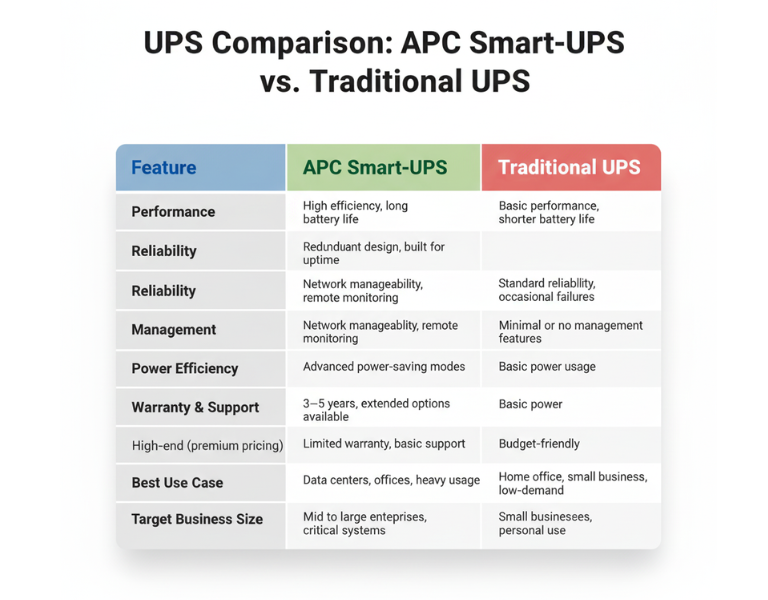
Comparison Table

Feature APC Smart-UPS Traditional UPS
Performance High efficiency, long battery life Basic performance, shorter battery life
Reliability Redundant design, built for uptime Standard reliability, occasional failures
Management Network manageability, remote monitoring Minimal or no management features
Power Efficiency Advanced power-saving modes Basic power usage
Warranty & Support 3?5 years, extended options available Limited warranty, basic support
Price Range High-end (premium pricing) Budget-friendly
Best Use Case Data centers, offices, heavy usage Home office, small business, low-demand
Target Business Size Mid to large enterprises, critical systems Small businesses, personal use

ÿ ÿ ÿ ÿ ÿ ÿ ÿ ÿ ÿ ÿ ÿ ÿ ÿ ÿ ÿ ÿ ÿ ÿ ÿ ÿ ÿ ÿ ÿ ÿ ÿ ÿ ÿ ÿ ÿÿ ÿ ÿ
Pros and Cons

APC Smart-UPS

Pros Cons
– Advanced network monitoring – Higher upfront cost
– Real-time health alerts – Requires setup and management
– Energy efficiency reduces costs – Overkill for small setups
– Longer battery life and proactive maintenance – More complex to install

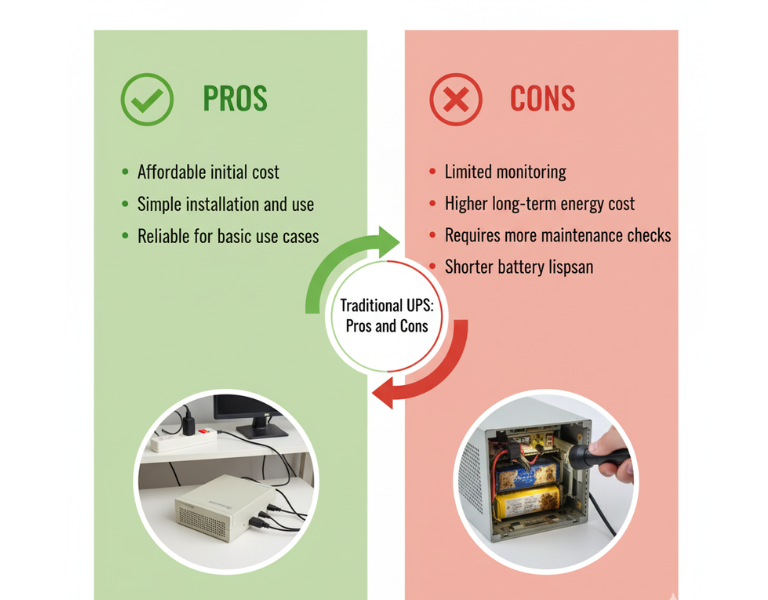
Traditional UPS

Pros Cons
– Affordable initial cost – Limited monitoring
– Simple installation and use – Higher long-term energy cost
– Reliable for basic use cases – Requires more maintenance checks
– Basic surge protection – Shorter battery lifespan

Expert Recommendation

For small businesses or home offices with limited infrastructure, a traditional UPS might be the most cost-effective choice. They?re simple to use and reliable for lower-demand environments, offering essential power protection without unnecessary complexity. However, if your business involves critical systems or you need remote monitoring across multiple locations, investing in an APC Smart-UPS will provide you with greater visibility and long-term savings. The upfront cost is higher, but the benefits of energy efficiency and remote management often outweigh the additional investment in the long run.


Real-World Use Cases

  • Design Studio (Small Business): A small design studio with 10 employees uses a traditional UPS system to protect their file servers and workstations. Since they don?t experience frequent power outages, the basic protection and lower upfront cost are sufficient for their needs.

  • Corporate Data Center (Large Enterprise): A data center with hundreds of servers relies on APC Smart-UPS units for continuous uptime. These units are monitored remotely, ensuring that any battery degradation is addressed before it becomes an issue, minimizing downtime.

  • Retail Store (Small Business): A retail store with a point-of-sale system and inventory management needs basic power protection. A traditional UPS is ideal for their low-maintenance requirements, offering reliability without overinvesting in features they won?t use.

  • Regional Office (Enterprise): A regional office for a large enterprise has several remote workstations that rely on network connectivity. APC Smart-UPS units provide energy efficiency and reduce the need for on-site monitoring. Staff can check UPS health remotely, reducing unnecessary visits and service calls.


Final Summary

Choosing between APC Smart-UPS and traditional UPS systems depends largely on your business size and needs. While traditional UPS systems work well for small-scale operations, APC Smart-UPS systems provide advanced features that make them ideal for larger enterprises or critical environments where uptime and energy efficiency are a priority.