
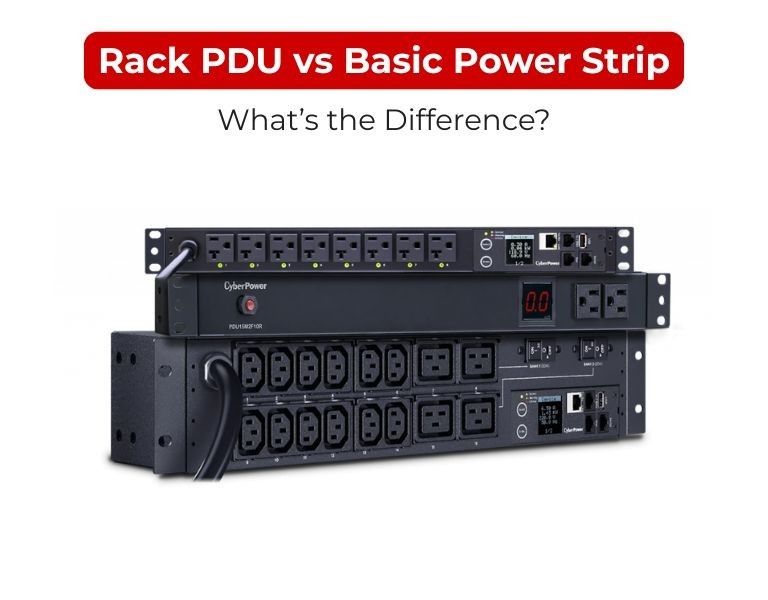
Introduction (direct answer first)
A rack PDU is designed for continuous, high-load IT environments with proper power distribution, monitoring, and safety controls.
A basic power strip is intended for low-load, non-critical use and lacks the reliability, protection, and scalability required in server racks.
Using a power strip in a data center rack is a risk?not a cost saving.
Use Case / Deployment Fit
Rack PDU fits when:
- Server racks and network cabinets
- Data centers and colocation environments
- High-density IT loads
- Redundant power architectures (A/B feeds)
Basic Power Strip fits when:
- Office desks and workstations
- Temporary setups
- Low-power devices (chargers, monitors)
Technical Breakdown
1. Load Capacity & Electrical Design
- Rack PDU: Designed for sustained high current (16A?32A+, single or 3-phase)
- Power Strip: Typically low current (6A?13A), not built for continuous load
Impact: Power strips overheat under rack-level loads.
2. Reliability Under Continuous Load
- Rack PDU: Engineered for 24/7 operation
- Power Strip: Not rated for constant high utilization
Impact: Higher failure risk with power strips in IT racks.
3. Monitoring & Visibility
- Rack PDU: Options include metered, switched, outlet-level monitoring
- Power Strip: No monitoring
Impact: No way to track load or prevent overload with power strips.
4. Redundancy Support
- Rack PDU: Supports dual-feed (A/B) architectures
- Power Strip: No redundancy design
Impact: Power strips cannot support enterprise uptime requirements.
5. Outlet Types & Compatibility
- Rack PDU: C13/C19 outlets for servers and enterprise gear
- Power Strip: Standard domestic sockets
Impact: Compatibility and secure connections are limited with power strips.
6. Mounting & Form Factor
- Rack PDU: 0U vertical or rack-mounted horizontal designs
- Power Strip: Loose, unmanaged placement
Impact: Poor cable management and airflow obstruction with power strips.
Comparison Table
| Feature | Rack PDU | Basic Power Strip |
|---|---|---|
| Intended use | Data center / rack | Home / office |
| Load capacity | High (16A?32A+) | Low |
| Continuous operation | Yes | Not reliable |
| Monitoring | Available | None |
| Redundancy support | Yes | No |
| Mounting | Rack-integrated | Loose |
| Safety | High | Limited |
Limitations & Trade-offs
Rack PDU limitations:
- Higher upfront cost
- Requires proper power planning
- Overkill for small office setups
Power Strip limitations:
- No overload visibility
- Not designed for critical systems
- High risk of failure under sustained load
- No integration with IT infrastructure
Procurement Insight
The price difference is minor compared to the risk.
- Rack PDU ? protects uptime and equipment
- Power strip ? introduces failure points
For any rack with servers, switches, or storage, a rack PDU is not optional?it is standard infrastructure.
Enterprise IT teams standardize onÿrack PDUs to ensure compatibility, safety compliance, and operational visibility, often sourcing through distributors likeÿDC Supplies for consistent rack deployments.
Real-world Scenarios
Scenario 1: Server Rack Deployment
Rack PDU is mandatory. Power strips cannot handle sustained load or provide redundancy.
Scenario 2: Office Workstation Cluster
Power strip is acceptable if load is minimal and non-critical.
Scenario 3: Network Closet
Entry-level rack PDU recommended for safety and cable management.
Scenario 4: Temporary Lab Setup
Power strip can be used short-term, but not for production.
Final Recommendation
- Use rack PDU for any rack-mounted IT equipment
- Use power strip only for non-critical, low-load environments
If there is any expectation of uptime, monitoring, or scalability, a rack PDU is the correct choice.